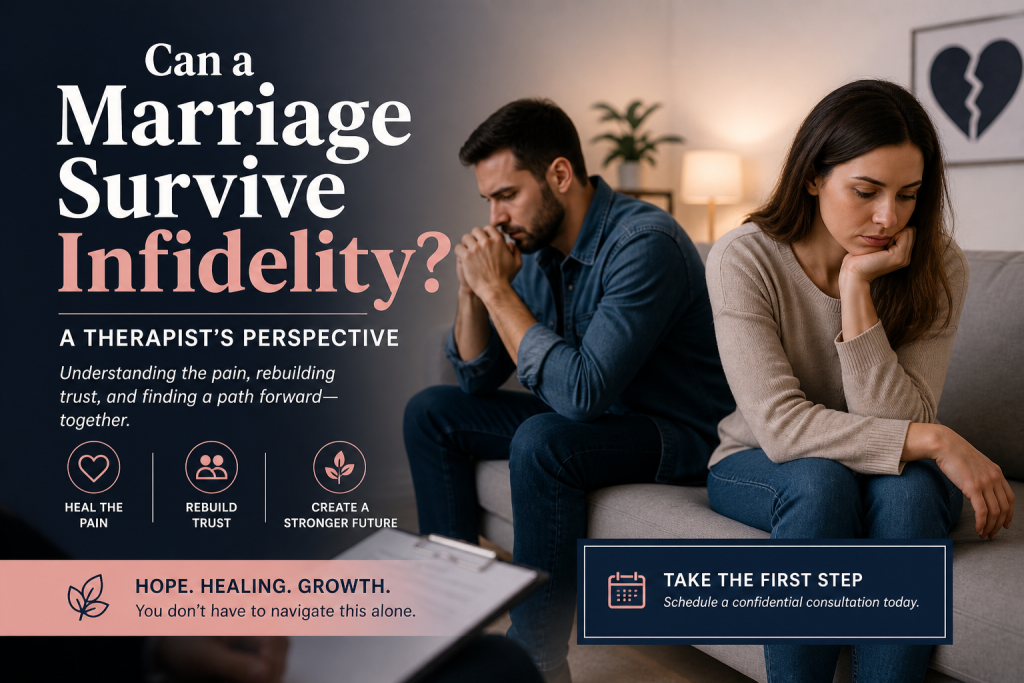
Can a Marriage Survive Infidelity? A Therapist’s Perspective
Infidelity is one of the most painful and destabilizing experiences a marriage can face. For many couples, discovering an affair feels like the end—trust is shattered, emotions run high, and the future becomes uncertain.
But here’s the truth: while infidelity can break a marriage, it doesn’t have to.
From a therapist’s perspective, many couples not only survive infidelity—but rebuild stronger, more honest, and more connected relationships than before.
The key lies in how both partners respond after the betrayal.
Why Infidelity Happens (It’s Not Always What You Think)
One of the biggest misconceptions about infidelity is that it only happens because someone is unhappy or “falls out of love.”
In reality, the reasons are often more complex.
Some common underlying factors include:
- Emotional disconnection over time
- Lack of communication or unresolved conflict
- Feeling unappreciated or unseen
- Opportunity combined with poor boundaries
- Personal struggles such as low self-esteem or stress
This doesn’t justify the betrayal—but understanding the “why” is essential for healing.
Without addressing the root cause, couples often remain stuck in cycles of blame and resentment.
The Immediate Aftermath: Shock, Pain, and Uncertainty
When infidelity is discovered, the emotional impact can feel overwhelming.
The betrayed partner may experience:
- Anger
- Anxiety
- Obsessive thoughts
- Loss of self-worth
- Difficulty trusting anything their partner says
The partner who cheated may feel:
- Guilt
- Shame
- Fear of losing the relationship
- Confusion about their own actions
This stage is often chaotic and emotionally intense—and it’s where many couples either begin to rebuild or start to fall apart.
Can Trust Ever Be Rebuilt?
This is usually the first question couples ask.
The answer is yes—but it’s not quick or easy.
Rebuilding trust requires:
Full Transparency
The partner who cheated must be willing to answer questions honestly and openly.
Secrecy is what damaged the relationship—transparency is what begins to repair it.
Consistent Actions Over Time
Trust is not rebuilt through words—it’s rebuilt through consistent behavior.
This includes:
- Keeping promises
- Being accountable
- Showing reliability
Over time, small consistent actions begin to restore a sense of safety.
Patience With the Healing Process
The betrayed partner’s healing doesn’t follow a straight line.
There will be setbacks, triggers, and emotional waves.
Both partners must be prepared for a long-term process—not a quick fix.
The Biggest Mistake Couples Make After Infidelity
One of the most common mistakes is trying to “move on” too quickly.
This often sounds like:
- “Let’s just forget about it”
- “I said I’m sorry, what else do you want?”
- “We should just focus on the future”
While the intention may be to avoid pain, skipping the healing process actually prolongs it.
Unprocessed emotions don’t disappear—they resurface later, often in more damaging ways.
What Healing Actually Looks Like
Healing from infidelity involves more than repairing the relationship—it also involves individual growth.
For the Partner Who Was Betrayed:
- Processing emotional pain
- Rebuilding self-esteem
- Learning to trust again (gradually)
For the Partner Who Cheated:
- Taking full responsibility
- Understanding the deeper reasons behind their actions
- Making meaningful behavioral changes
For the Relationship:
- Improving communication
- Rebuilding emotional intimacy
- Creating new, healthier patterns
Is It Better to Stay or Leave?
This is one of the hardest questions—and there’s no one-size-fits-all answer.
Some couples choose to separate, and that can be the right decision depending on the situation.
However, many couples choose to stay and rebuild—and succeed.
Factors That Influence the Outcome:
- Willingness of both partners to do the work
- Level of honesty and accountability
- Desire to rebuild the relationship
- Presence of ongoing dishonesty or repeated behavior
If both partners are committed to growth, healing is absolutely possible.
How Therapy Helps Couples Recover
Trying to navigate infidelity alone can feel overwhelming.
This is where professional guidance becomes incredibly valuable.
A therapist provides:
A Safe, Neutral Space
Both partners can express emotions without escalation or judgment.
Structured Communication Tools
Many couples struggle to communicate effectively after betrayal.
Therapy introduces frameworks that help both partners feel heard and understood.
Guidance Through the Healing Process
Instead of guessing what to do next, couples follow a structured path toward recovery.
Accountability and Progress Tracking
Therapy ensures that both partners stay committed and continue moving forward.
Rebuilding a Stronger Marriage After Infidelity
While it may not seem possible at first, many couples report that their relationship becomes stronger after working through infidelity.
Why? Because they address issues that were previously ignored.
They learn to:
- Communicate more openly
- Set healthier boundaries
- Be more emotionally connected
- Appreciate each other on a deeper level
In some cases, the relationship becomes more authentic than it ever was before.
Signs Your Marriage Can Recover
Not every relationship will survive infidelity—but many can.
Here are positive signs:
- Both partners are willing to work on the relationship
- The partner who cheated takes full responsibility
- There is genuine remorse and empathy
- Communication is improving
- Both partners want to rebuild trust
If these elements are present, the chances of recovery are significantly higher.
When to Seek Professional Help
If you’re dealing with infidelity, timing matters.
The sooner you seek guidance, the better your chances of navigating the situation in a healthy way.
You should consider therapy if:
- You feel stuck in constant arguments
- Trust feels impossible to rebuild
- Emotions are overwhelming
- You don’t know how to move forward
Waiting too long often allows resentment and distance to grow.
A Realistic Perspective on Healing
It’s important to set realistic expectations.
Healing from infidelity:
- Takes time
- Requires effort from both partners
- Involves uncomfortable conversations
- Is not linear
But with the right support and commitment, it is absolutely achievable.
You Don’t Have to Navigate This Alone
Infidelity can make you feel isolated, confused, and unsure about the future.
But you don’t have to figure it out on your own.
Working with a trained therapist can provide clarity, direction, and a path forward—whether that means rebuilding your relationship or making a healthy decision about what comes next.
Take the First Step Toward Healing
If you’re asking whether your marriage can survive infidelity, it means you’re already searching for answers—and that’s a powerful first step.
The next step is getting the right support.
If you’re ready to:
- Rebuild trust
- Improve communication
- Heal from betrayal
- Move forward with clarity
Reach out today to schedule a confidential consultation.
Professional guidance can help you navigate this difficult time and give your relationship the best possible chance to heal and grow.
Final Thought
Infidelity changes a relationship but it doesn’t automatically end it. With honesty, commitment, and the right support, many couples find a way not just to survive—but to rebuild something stronger than before.